Raman spectroscopy - an analysis
This is incomplete. I just update on the go.
It’s been a while since there is anything happening on the frontal page. And, considering that I just have done a small essay on Raman spectroscopy, and the topic of optical physics, it’s a good thing to visit this topic a bit further than before.
Introduction
This article, or rather, the small post (not so small, however) will introduce certain topics on optical physics and its interaction with materials, the interpretation of such events, scattering and Raman scattering, and spectroscopic application of the exact jargon we just threw around there, and certain data-specific, machine learning approach - coincidentally my essay as well.
Hopefully it’s will be nice and shiny.
I. Optical physics
So, what is it about? The theory of optics, and whatever going on with lights, have various conjectures, theories and interpretation. At least to be familiar of one such, we might as well proceed with the simplest one - ray optics, and this, alongside wave optics, found the foundation of the discussion for modern optics.
One particular aspect of why rays and wave optics are easier than others comes from the fact that they are developed, and treated succinctly without the knowledge of electromagnetism. Of course, Maxwell was born in the 19th century and not earlier, so that is understandable. So, here, light is not considered to be an electromagnetic phenomenon.
Afterward, we will discuss the formalism into electromagnetic effects by Maxwell, and the dilemma of the photoelectric effect - one such effect that changes the perception and interpretation of what lights, and other matters to be.
I.1. Ray optics
While the nature of light is far more complex than one can simply make it out of such, the naive definition of light can be defined two-fold - a dynamic container of energy to specific configuration, and by the configuration, either wave-like behaviour, and particle-like observations. For ray optics, the most correct model of said treatment is caleld the Corpuscular theory of light, by Issac Newton and Pierre Gassendi (the first guy I know - everyone knows - the second… well not quite), where matter or light is made up of small particles called corpuscles (or ‘little particles’).
Notice that by the above passage, we directly infer that, if you do not know by now, and to clarify, that light can be both waves, or streams of particles. As a wave, we can speed of the propagation speed of the wave \(\omega\) as \(v(\omega)=\dot{x}=f\lambda\) for \(\lambda\) the wavelength. However, for ray optics, we consider only somewhat the particle case more.
The fundamental assumption in the theory of ray optics is that light travels in the form of rays. A ray means, or represents a beam of light, however, this ray is often not monochromatic - but polychromatic - or with the shade of multiple colors. This model of light is fairly limited, since there exist only two ways of interaction: reflection or refraction. We would want to see what is more important in such theory.
For light to travels, as for things to live, it propagates, or moves in a media. Hence, most of our results lives in what is called optical media. Space, without anything, is one kind of exception in such space. Assuming the media are lossless1, we can characterize them completely by a quantity called index of refraction, denoted by \(n\). For the empty space, \(n=1\), and usually, \(n\geq 1\), or by how light is bent (refracted, or strays from its original vector directive).
1 By Ohm’s law, \(\mathbf{J}=\sigma \mathbf{E}\), where \(\sigma\) is the conductivity. A media that is lossless has the conductivity \(\sigma\) to be negligible, its permeability \(\mu\) and permittivity \(\epsilon\) finite. When an electromagnetic wave propagates through a lossless medium, the amplitude of its electric field or magnetic field remains constant throughout the propagation. Thus, we can call it a ‘non-interrupting’ medium for waves.
The fundamental principle of ray optics, called Fermat’s principle, concerns of the optical path length. Consider a path \(\mathbf{r}(s)\) between points \(A\) and \(B\) in an optical medium; this path is paramterized by \(s\), so that \(A=\mathbf{r}(0), B=\mathbf{r}(d)\), where \(s,d\to L\) for dimension. Then, the optical path length is the length is this path, weighted by the local refractive index. That is
\[ \ell [\mathbf{r}]:= \int_{0}^{d} n(\mathbf{r}) \: ds \]
This quantity is proportional to the time light takes to traverse the path, \(\Delta t= \ell /c_{0}\). Fermat’s principle states that the optical rays traverse paths that satisfy \(\delta \ell = 0\), or the path length is the same throughout the path. This principle is also often called the principle of least time. For ray optics, this principle settles the analysis and path calculations.
Paraxial rays.
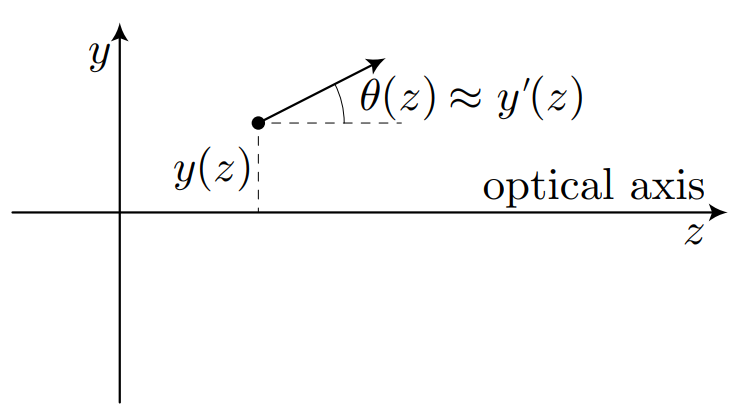
For ray optics, we need a formalism for keeping track of optical rays. Represent a ray by a vector, which keep track of the position and direction of the ray with respect to the optical axis, the reference axis for optical propagation. The displacement \(y\) from the optical axis, and the direction \(\theta\) are sufficient to completely specify the ray at a particular longitudinal position \(z\).
 {: .align-center width=400px}
An observation can conclude that \(\theta = y'\), which then makes the coordinate to be
\[ \begin{bmatrix} y \\ \theta \end{bmatrix} = \begin{bmatrix} y \\ y' \end{bmatrix} \]
For any optical system of rays, we want to calculate the change in the ray vectors. In this sense, we get the model of optical system as a transformation of the ray vectors during its propagation.
\[ \begin{bmatrix} y \\ \theta \end{bmatrix} =\mathbf{f} \begin{bmatrix} y \\ y' \end{bmatrix} \]
for \(\mathbf{f}\) modelling the optical system. Dealing with multivariate expressions, we obtain the approximation:
\[ \begin{bmatrix} y_2 \\ y_2' \end{bmatrix} = \left. \begin{bmatrix} \frac{\partial f_1}{\partial y_1} & \frac{\partial f_1}{\partial y_1'} \\ \frac{\partial f_2}{\partial y_1} & \frac{\partial f_2}{\partial y_1'} \end{bmatrix}\right|_{y_1 = y_1' = 0} \begin{bmatrix} y_1 \\ y_1' \end{bmatrix} +\text{higher-order terms in } y_1, y_1' \]
by Taylor-expanding the function. This is the paraxial approximation. The matrix of derivatives is the transfer matrix that represents the optical system in the paraxial approximation. Hence, we obtained an effective formalism for treating change of optical system.
I.2. Wave optics
Another theory of light, much different than what is perceived as rays, or particle stream by Newton’s corpuscular theory, is Crhistiaan Huygen’s wave theory (1960, Traité de la Lumière). For such theory, it follows: 1. Light travels in a hypothetical medium ether (high elasticity with very low density) as waves. 2. He proposed that light waves are of longitudinal nature. Later on, it was found that they are transverse.
The need for the theory of wave optics comes rather conveniently. While geometrical optics (ray optics) can explain relection, refraction, and other effects, sone phenomena like interference and diffraction can only be satisfactorily described, at least for then, only by considering light as waves. We should however, note that, nevertheless, we are still only approximating the world, or in this case, the light. Classical physics analyzes lights by considering its abstraction to either particles (corpuscular) or by waves (Huygen’s), both of them at the point is based on pure travel experiments. We know light moves. And that’s it.
Waves - oscillation and vibration
Before anything, let’s summarize that is there to be said of waves, since we are trying to interpret it so.
Everything likes to be in equilibrium. Well, most of them. Nevertheless, consider a relatively stable and in-equilibrium objects and system surrounding it. Any finite change constitutes to its present-future state transition perturbs this equilibrium to certain level. For example, a stationary object in which the forces surrounding it, acting on it, and its existence (by Newton, rigid bodies cancel the forces out) is in equilibrium, and you push it, introducing additional outer subjects in, you have perturbed the system, and make it moving.
Huygen’s principle
There’s something called wavefront. Consider throwing stone on a calm pool of water - the waves spread out from the point of impact. Every point on the surface oscillates with time. At any instant, if one take a picture of the wave behaviour would show circular rings of the highest amplitude. The waves at any given ring, or any given circular region of radius \(r\) from the point of impact is in phase - they are moving in the same direction and oscillate at the same distance. Such a locus of points, which oscillate in phase is called a wavefront - thus, a wavefront is defined to be a surface of constant phase.
Set the source as \(S\), for \(r'\) the distance from the source to point \(O\).
II. Raman scattering
Raman effect, or scattering, is a type of optical interaction phenomenon. As we have interpreted earlier, our experiments with lights has been conducted in a fairly standard way of seeing light interacts with matters, or no at all. We would want to remember that light is an object moving in the consideration of different medium - including vacuum being classified as one, and air, and mediums contains materials of sufficient size.
Any time propagation light (or any type of radiation) encounters a boundary for an object that is different from the material the light is coming from, some fraction of the light will be reflected from that surface. For simple geometries, this is known as the Fresnel reflection for flat surfaces, Mie scattering for scattering from spheres, or Rayleigh scattering for sub-wavelength particles. By conservation, those events are called elastic events, such that if we isolate the system into \(I-A-O\) or input (I)- action (A) - output chain, \(E_{I}=E_{O}\) and the light remains the same. The other way around, where something is missing at the end - either because the medium exchange the luminiferous energy into something else (thermodynamic energies), is called inelastic (referencing exactly momuntum transfer). And in such, one particular event is Raman scattering, and hence, the purpose why we are here.
Preliminary (or recap)
II.1. Basic definition
The expression material system will be used for the matter involved in the scattering act. This will always be taken to be an assembly of free rotating, non-interacting molecules. 2. Radiation refers to electromagnetic radiation, characterized among other things, by frequency \(f\) and related quantities. The frequency in interest is the angular frequency \(\omega\:(\mathrm{rad\:s}^{-1})\). 3. In the material system, the energy of a molecule in its initial state \(i\), before the interaction, is defined by \(E_{i}\), in its final state \(f\), is defined by \(E_{f}\). The ground is denoted by \(E_{g}\). Excited electronic state is denoted by \[E_{e}\to E_{e_{1}},\dots,E_{e_{n}},\dots\] 4. Transition energy between states are \(E_{fi}=E_{f}-E_{i}\), and can be defined more by the associated \(\omega\): \[E_{fi}=\hbar \omega_{fi},\omega_{fi}=\omega_{f}-\omega_{i}\] 5. The incident radiation will be taken to consists of one or more monochromatic EM waves (of singular colour) of frequency \(\omega_{1},\omega_{2},\dots\) with photon energies \(\hbar \omega_{1},\hbar \omega_{2},\dots\) If there is only one monochromatic component, the interaction is called one-colour process. Conversely, for \(M\) components, it is called \(\mathbf{M}\)-colour process. 6. All light-scattering processes are characterized by the fact that, unlike direct absorption, the energy of an incident photon is not required to be equal to the energy corresponding to the difference between two discrete energy levels of the material system.
II.2. Optical processes
Optical properties and processes observed in optical system consists of several definitions and terms describing such.
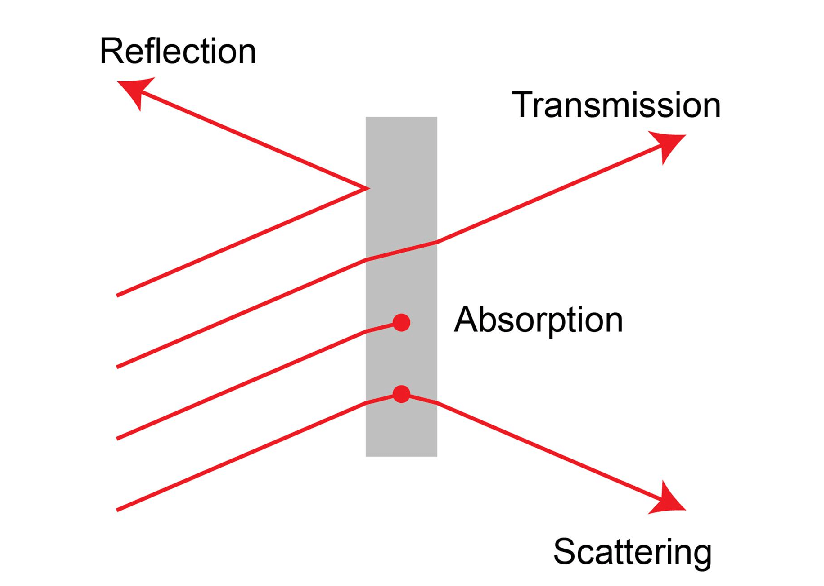
The simplest group of optical phenomena consists of reflection, propagation, and transmission. These phenomena can occur while light propagates through an optical medium. In the propagation phase (of the interaction between material and the incident light that was not reflected), there are several phenomena that can happens: 1. Refraction: Reduction of velocity when exiting the material (entering free space), which causes the bending of lights. 1. Question: Why this happens? Excluding the Snail’s law, or Huygens’ principle, what is the “physical” explanation? 2. Absorption: This occurs if the frequency \(f\) of the light is resonant with the transition frequencies of the atoms in the medium (this occurs during atomic electron transition process, governed by \(E=hf\)), which attenuates the incident light gradually. Selective absorption is the result for coloration in many materials. 3. Luminescence: Is the phenomena of spontaneous emission of light, from the excited atoms of the material. This is accompanied, usually by absorption, such that to pull the atom state into excited state. Certain properties are 1. Light emitted during de-excitation process is non-aligned to the incident light propagating through the material. 2. Frequency is different, and based of excited electron and material’s type. 3. There’s a characteristic amount of time for the de-excitation process to occurs. 4. Not always accompanies absorption as a reemission process, since excited energy can dissipate before the characteristic time. 4. Scattering: Redirection and changes of frequency of incident lights propagating through the medium. The scattering effect is elastic if frequency is constant, but inelastic if it varies. Other than the abovementioned phenomena, there’s nonlinear optical phenomenon, such as frequency double. All of which happens within high intensity light.
The Raman effect
When monochromatic radiation of frequency \(\omega_{1}\) is incident on system of material, most of it is transmitted without change, but some scattering occurs.
 {: .align-center width=400px}
If the frequency content of the scattered radiation is analysed, aside from \(\omega_{1}\), there is also various new frequencies of type \(\omega_{1}\pm \omega_{M}\). The frequency \(\omega_{M}\) in a molecular system are found to lie principally in the ranges associated with transitions between rotational, vibrational and electronic levels. Those levels are referring to energy level of excited state aside from the ground state \(E_{g}\). For rotational for example, the diatomic molecule has the rotational energy level at \[E(J)=B(J+1)\] where \(J\) is the quantum number of the total rotational angular momentum, \(B\) is the rotational constant, and \[B=\frac{h}{2\pi^{2}cI}\] where \(I=\mu r^{2}\) being the moment of inertia of the molecule. As such, there are a lot of excited state in those ranges.
Scattering without change of frequency is called Rayleigh scattering, and that with change of frequency is called Raman scattering after C. V. Raman. Raman bands at frequencies less than the incident frequency are referred to as Stokes-band scattering, while the opposite is called anti-Stokes scattering. For Mie scattering, then it is a version of Rayleigh (technically speaking) but much stronger.
Statistically, during the event of light incidents that leads to scattering effect, most light passing through undergoes Rayleigh scattering. This is an elastic effect, which means that the light does not gain or lose energy during the scattering. Therefore, it stays at the same wavelength.
Raman scattering is then different in that it is inelastic. The light photons lose or gain energy during the scattering process, and therefore increase or decrease in wavelength respectively.
For most experiments and practical purposes, we often take, for such reason, Rayleigh scattering as the basis for selecting the region of scattering frame that we want to focus on. Usually, anti-Raman is not a good indicator and readable spectrum, since it blends in with large noises and thereof, hence we would like to use the left-hand side - Stokes line more than enough. This does not mean that anti-Stokes holds no values or information - from a statistical standpoint however - capturing anti-Stokes is much more difficult.
The origin for the Stokes name. According to Stokes’ law, the frequency of fluorescent light is always smaller or at most equal of that exciting light. Stokes lines are thus those that correspond to Stoke’s law, and anti-Stokes line are those that contradict it. This is adopted for the Raman effect, in spite of its difference from the original intended term of usage.
Spectroscopy
Spectroscopy utilizes electromagnetic radiation, when interaction with atoms and molecules. Their ‘after effect’ varies, for example, being induced absorption, spontaneous emission, induced emission. Some of the more direct descriptions includes luminescence and fluorescence, scattering, and reflections. Of all, the typical interest is based on the event of scattering.
Even with some of its drawback, characteristic scattering is less susceptible to the environment (fluorescence spectroscopy), spectrum is easier to decodes (IR spectroscopy), somewhat easier to set up and maintain (reflection-absorption spectroscopy), and others.
Traditionally, Raman used light from the Sun focused through a telescope to achieve a high enough intensity in his scattered signal.
Modern spectrometers use both improved sources and more sensitive detectors to obtain better results. Nowadays, lasers are normally employed due to their high intensity, single wavelength and coherent beam instead.
Comparison to other spectroscopic methods
In the commonly used infrared absorption spectroscopy, infrared light excites certain vibrational frequencies of molecules and is absorbed by them, not re-emitted. This gives an absorption spectrum, with bands at characteristic wavenumbers. Other absorption techniques use higher energy radiation (e.g. ultraviolet) and raise electrons to an excited state.
Fluorescence occurs when light (often UV) is incident on a molecule and promotes an electron to an excited state. The molecule is also vibrating. Firstly it relaxes from its vibrational state, dissipating this energy (normally as heat). Then, when it drops back down to the ground state, the photon released has less energy than the incident photon. The increased wavelength often means that the light is now in the visible region. This is how fluorescent lighting works, by ionisation of mercury to produce UV light, which is then absorbed by a fluorescent coating and re-radiated as visible light. Fluorescence can also be used for spectroscopy.
Under such consideration, Raman is listed of several advantages: - Can be used with solids, liquids or gases. - No sample preparation needed. For infrared spectroscopy solids must be ground into KBr pellets or with nujol to form a mull. - Non-destructive No vacuum needed unlike some techniques, which saves on expensive vacuum equipment. - Short timescale. Raman spectra can be acquired quickly. - Can work with aqueous solutions (infrared spectroscopy has trouble with aqueous solutions because the water interferes strongly with the wavelengths used) - Glass vials can be used (unlike in infrared spectroscopy, where the glass causes interference) - Can use down fibre optic cables for remote sampling.
Conversely, their drawbacks are not lacking: - Cannot be used for metals or alloys. - The Raman effect is very weak, which leads to low sensitivity, making it difficult to measure low concentrations of a substance. This can be countered by using one of the alternative techniques (e.g. Resonance Raman) which increases the effect. - Can be swamped by fluorescence from some materials.
The second point might be one of the biggest drawback for Raman spectroscopic system - it is simply too expensive to guarantee specific error and retrieval acceptance bound when handling experiments related to spectroscopic extraction. Even the best, most DIY-like spectroscoper costs almost $4000 2
2 See this article on ACS.