Raman spectroscopy research
This is the presentation provided and procured for the purpose of using it to introduce the topic and organization of Raman theory research for potential participants. As of now, it is also the outline.
Preliminary
First, we have several resources for you to look into. For now, we have this essay from me that talk about such issue clearly, and a few more sources that you can refer to. For tools related to Raman spectroscopy and spectroscopy in general, look into this post.
Additional member’s system is in GitHub (TBH) and this sheet with all the content of organization possible, for now.
The topic of Raman Spectroscopy
It is widely considered for spectroscopy, and Raman spectroscopy specifically, to be an important field of study and tools of analysis. The need for accurate detection, material fingerprinting, non-destructive probing, drug detections, medicine and pathological diagnosis, and various on-field examination requires tools of Raman spectroscopy and its properties in major applications.
With that, comes of great importances in understanding Raman scattering itself, for analysis and manipulation of Raman data received from the process and measurements.
![]()
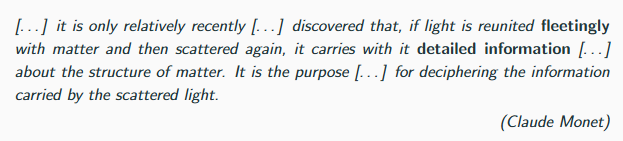
The famous quote of Claude Monet on lights and matter
By that, we are interested in scattered lights, in which induces Raman scattering. This is our main character.
Inherently, we can see that Raman scattering, the effect of scattering with the ‘pattern’ of which C. V. Raman drew out in experiments, is entangled of the most basic subject and object of science - lights and main matter.
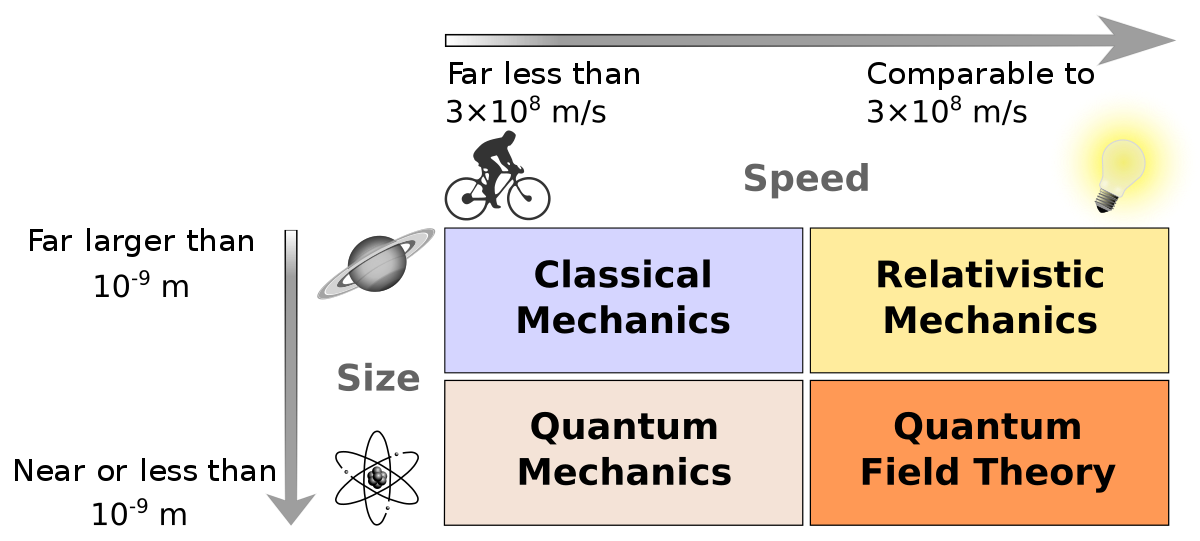
Thereby, there are inherently historical shifts, and many interpretations and explanations toward which the effect can be understood. This includes the first formal system, classical physics, and the more modern, quantum mechanics of which can be used to explain this effect softly.
![]()
The regime of which everything works. Each of them differs, and the more general and widespread an effect is, the more susceptible it is to regime changes.
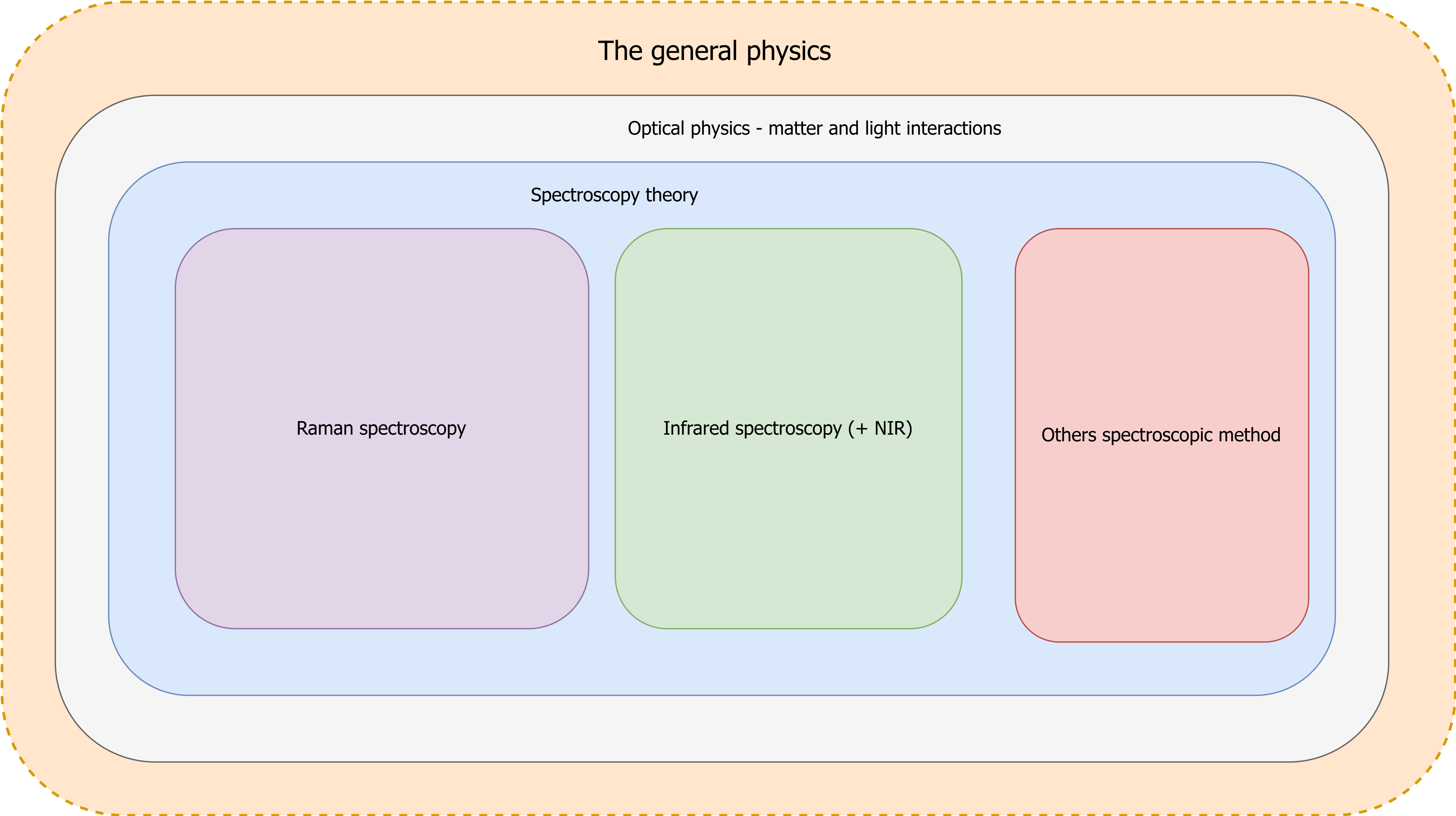
As such, we require a basic hierarchical level of approach to this particular problem, which will be mentioned later on forward.
![]()
The hierarchical dependency of subject matters, coming down to Raman spectroscopy.
Within the following up, let us conclude what is known in a simpler approach (will be added further more later on).
Basic definitions
- The expression material system will be used for the matter involved in the scattering act. This will always be taken to be an assembly of free rotating, non-interacting molecules.
- Radiation refers to electromagnetic radiation, characterized among other things, by frequency \(f\) and related quantities. The frequency in interest is the angular frequency \(\omega\:(\mathrm{rad\:s}^{-1})\).
- In the material system, the energy of a molecule in its initial state \(i\), before the interaction, is defined by \(E_{i}\), in its final state \(f\), is defined by \(E_{f}\). The ground is denoted by \(E_{g}\). Excited electronic state is denoted by \[E_{e}\to E_{e_{1}},\dots,E_{e_{n}},\dots\]
- Transition energy between states are \(E_{fi}=E_{f}-E_{i}\), and can be defined more by the associated \(\omega\): \[E_{fi}=\hbar \omega_{fi},\omega_{fi}=\omega_{f}-\omega_{i}\]
- The incident radiation will be taken to consists of one or more monochromatic EM waves (of singular colour) of frequency \(\omega_{1},\omega_{2},\dots\) with photon energies \(\hbar \omega_{1},\hbar \omega_{2},\dots\) If there is only one monochromatic component, the interaction is called one-colour process. Conversely, for \(M\) components, it is called \(\mathbf{M}\)-colour process.
- All light-scattering processes are characterized by the fact that, unlike direct absorption, the energy of an incident photon is not required to be equal to the energy corresponding to the difference between two discrete energy levels of the material system.
First, spectroscopy
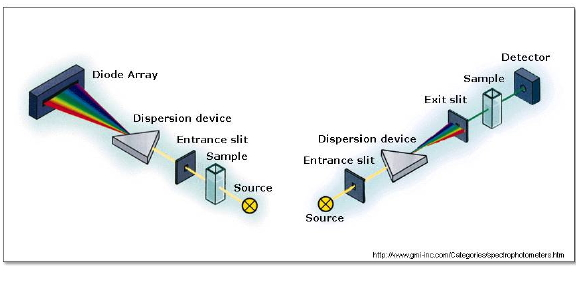
Spectroscopy utilizes electromagnetic radiation, when interaction with atoms and molecules. Their ‘after effect’ varies, for example, being induced absorption, spontaneous emission, induced emission. Some of the more direct descriptions includes luminescence and fluorescence, scattering, and reflections. Of all, the typical interest is based on the event of scattering.
![]()
An array of typical spectroscopic system
Even with some of its drawback, characteristic scattering is less susceptible to the environment (fluorescence spectroscopy), spectrum is easier to decodes (IR spectroscopy), somewhat easier to set up and maintain (reflection-absorption spectroscopy), and others.
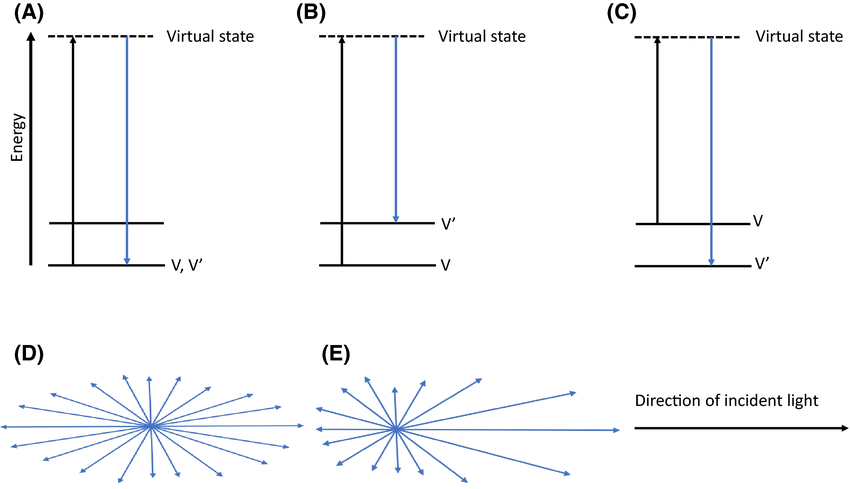
Scattering without change of frequency is called Rayleigh scattering, and that with change of frequency is called Raman scattering after C. V. Raman. Raman bands at frequencies less than the incident frequency are referred to as Stokes-band scattering, while the opposite is called anti-Stokes scattering. For Mie scattering, then it is a version of Rayleigh (technically speaking) but much stronger.
![]()
Diagram of scattering transition level.
Rayleigh and Raman spectroscopy
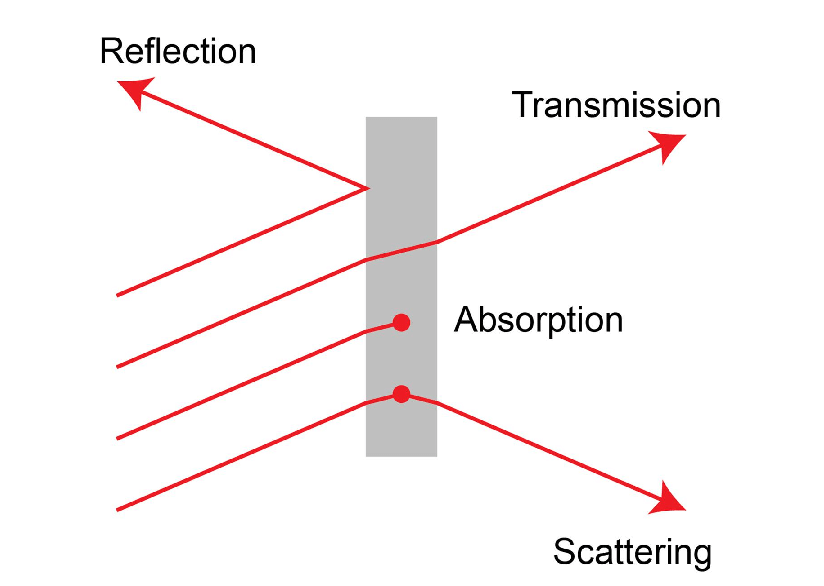
When monochromatic radiation of frequency \(\omega_{1}\) is incident on system of material, most of it is transmitted without change, but some scattering occurs.
![]()
Illustrative diagram on transitioning periods
If the frequency content of the scattered radiation is analysed, aside from \(\omega_{1}\), there is also various new frequencies of type \(\omega_{1}\pm \omega_{M}\). The frequency \(\omega_{M}\) in a molecular system are found to lie principally in the ranges associated with transitions between rotational, vibrational and electronic levels.
In the new quantum formulation, those levels are referring to energy level of excited state aside from the ground state \(E_{g}\). For rotational for example, the diatomic molecule has the rotational energy level at
\[E(J)=B(J+1)\]
where \(J\) is the quantum number of the total rotational angular momentum, \(B\) is the rotational constant, and
\[
B=\frac{h}{2\pi^{2}cI}
\]
where \(I=\mu r^{2}\) being the moment of inertia of the molecule.
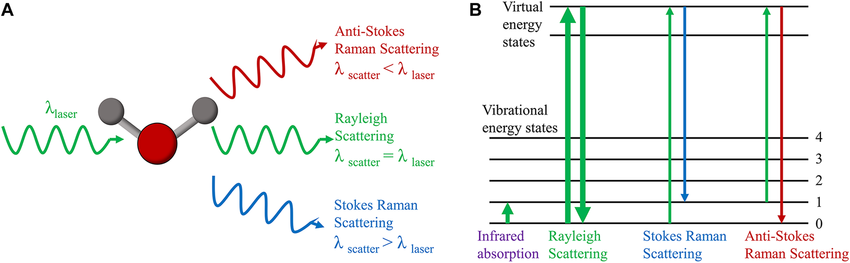
Statistically, during the event of light incidents that leads to scattering effect, most light passing through undergoes Rayleigh scattering. This is an elastic effect, which means that the light does not gain or lose energy during the scattering. Therefore it stays at the same wavelength.
![]()
Elastic and nonelastic energy transition model
Raman scattering is then different in that it is inelastic. The light photons lose or gain energy during the scattering process, and therefore increase or decrease in wavelength respectively.
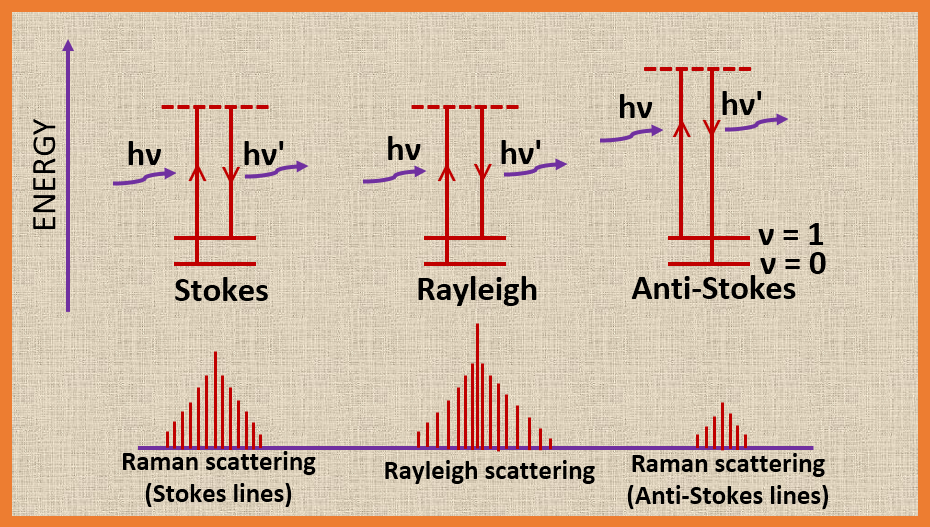
The two variants of Raman scattering is illustrated in the following figure.
![]()
The difference between two mode of Raman scattering
For most experiments and practical purposes, we often take, for such reason, Rayleigh scattering as the basis for selecting the region of scattering frame that we want to focus on. Usually, anti-Raman is not a good indicator and readable spectrum, since it blends in with large noises and thereof, hence we would like to use the left-hand side - Stokes line more than enough.
Trivia - origin of Stoke and anti-Stoke
According to Stokes’ law, the frequency of fluorescent light is always smaller or at most equal of that exciting light. Stokes lines are thus those that correspond to Stoke’s law, and anti-Stokes line are those that contradict it. This is adopted for the Raman effect, in spite of its difference from the original intended term of usage.
Trivia 2 - why we do not use anti-Stoke (usually)
The difference in intensity of the Stokes and anti-Stokes components is due to the different number of molecules in each state initially. The population follows the Boltzmann distribution: \[
N \propto\left( { - {E \over {{k_B}T}}} \right)
\]
Therefore there are exponentially fewer molecules that start out in the higher energy vibrational state. Since it is these that give rise to the anti-Stokes scattering, this is much less intense. The disparity is also reduced with increased temperature, and the difference can be used as a measure of temperature.
A typical Raman experiment
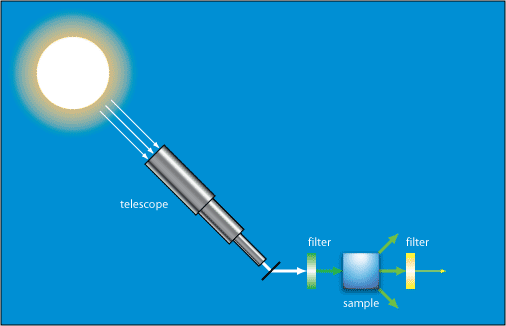
Traditionally, C. V. Raman (1918) used light from the Sun focused through a telescope to achieve a high enough intensity in his scattered signal.
![]()
The mundane and old technique of sun-exposure Raman source, use in the paper of C. V. Raman
Modern spectrometers use both improved sources and more sensitive detectors to obtain better results. Nowadays, lasers are normally employed due to their high intensity, single wavelength and coherent beam instead.
The fact that Raman spectroscopy is discovered and investigated further before quantum mechanics was born, is a problem in itself. As such of the conflict between two regimes.
Our work is then to resolve it, in a way of partially unifying an observation on what is there, and not at all originally think of something.
Organization
We expected to finish this by late-March, early-April 2026. So counting from November, it will be around six months of development and writing.
For development per-week basis, we expect to use around 6–10 hours a week, depends on the time available to individual members.
There are mainly four phases:
- General physics review and connections to (Raman) spectroscopy.
- Spectroscopy and vibrational spectroscopy.
- Raman spectroscopy in general - classical outlook.
- Raman spectroscopy in general - quantum outlook.
The final part is the conclusion of the map between the two, questions, inquiries, unresolved problems, and so on about the theory itself.